

ROKE's Practical Guide: Choosing the Right Wholesale Stainless Steel Fittings Manufacturer for High-Pressure Systems

Start With the Material Specification, Not the Price List
Material grade verification is the first — and most frequently skipped — step in supplier evaluation. For high-pressure stainless steel fittings, the difference between SS304 and SS316 is not marginal. SS316 incorporates molybdenum, which substantially improves resistance to pitting corrosion in chloride-containing environments. This matters in offshore, chemical, and marine applications where exposure to seawater or process chemicals is routine. Beyond grade selection, the applicable manufacturing standard governs dimensional compliance and pressure performance. ASME standards apply to pipe fittings with NPT threads — covering working temperature limits, thread geometry, and pressure ratings. DIN 2353 and ISO 8434 govern ferrule-type hydraulic and tube fitting geometry, including ferrule deformation characteristics, seating surface angles, and thread engagement criteria. Procurement teams should cross-reference a supplier's material mill certificates against the manufacturing standard claimed for each product line. A supplier that references ASME or DIN in product documentation but cannot provide traceable material certification is presenting compliance as a label rather than a verifiable engineering position.
Evaluate Product Breadth as a System Compatibility Signal
Individual fitting performance is only one part of the evaluation. High-pressure fluid systems integrate multiple component types — fittings connect to tubing, valves route flow between circuits, filters protect instrumentation, and flanges transition between pipe systems. When these components originate from different manufacturers with different dimensional tolerances, interface compatibility becomes a design variable rather than a given. A manufacturer whose catalog covers Tube Fittings in both metric and fractional configurations, Hydraulic Fittings across straight, elbow, tee, cross, and bulkhead configurations, Pipe Fittings including NPT-threaded variants, Flared Tube Fittings, Dielectric Tube Fittings, Filters, Quick Connects, Seamless Tubing, Valves, and Flanges provides a sourcing foundation where dimensional standards propagate consistently across the system. Nantong ROKE Fluid Equipment Co., Ltd. produces this full range from its facilities in Hai'an High-Tech Zone, Nantong — a product breadth that reflects deliberate engineering coherence rather than incremental catalog expansion.
Production Scale and Automation — Why Batch Consistency Matters More Than Capacity Numbers
Monthly output figures frequently appear in supplier profiles as supply security indicators. However, for precision-critical components, production volume is better understood as a quality consistency signal. A manufacturer running 20 automated production lines at a monthly output exceeding two million pieces generates continuous process data: dimensional measurements, thread pitch records, surface finish values, and torque outputs across every production run. This data infrastructure supports genuine quality management — it creates the evidence base that ISO 9001 audit cycles examine and that non-conformance tracking systems draw on. Manual production at lower volumes cannot replicate this, particularly for the dimensions that determine sealing performance: ferrule outer diameter, seating surface angle, and thread engagement depth. Batch-to-batch variation in these parameters accumulates into system-level performance differences under cyclic pressure loading. Procurement teams benefit from asking specific questions during supplier qualification: what percentage of production runs on machine-controlled lines, what in-process inspection intervals apply, and how non-conformances are documented and resolved. ROKE's 20-line automated production environment reflects this principle in operational terms, not just as a capacity metric.
Match the Certification Portfolio to the End Application
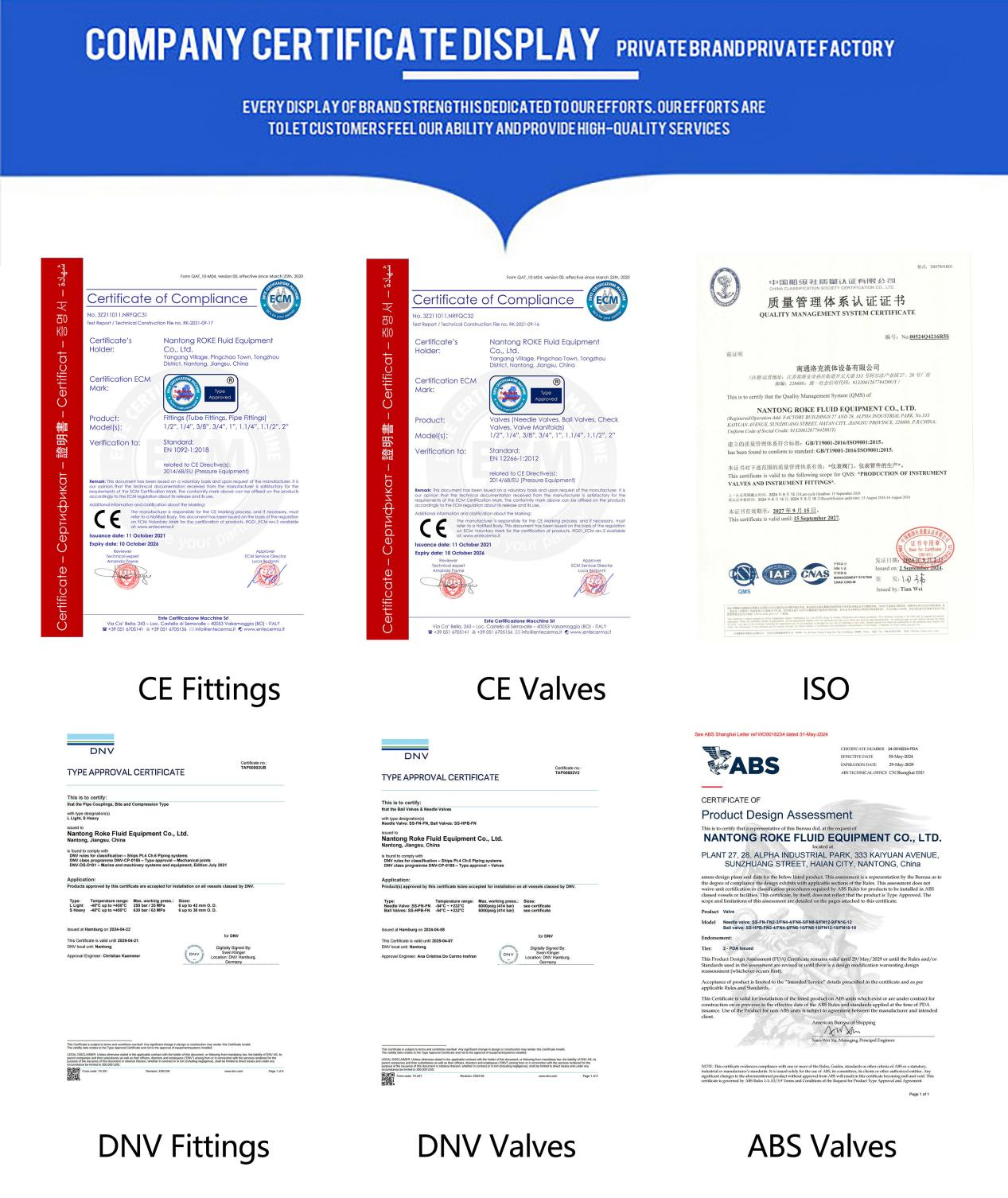
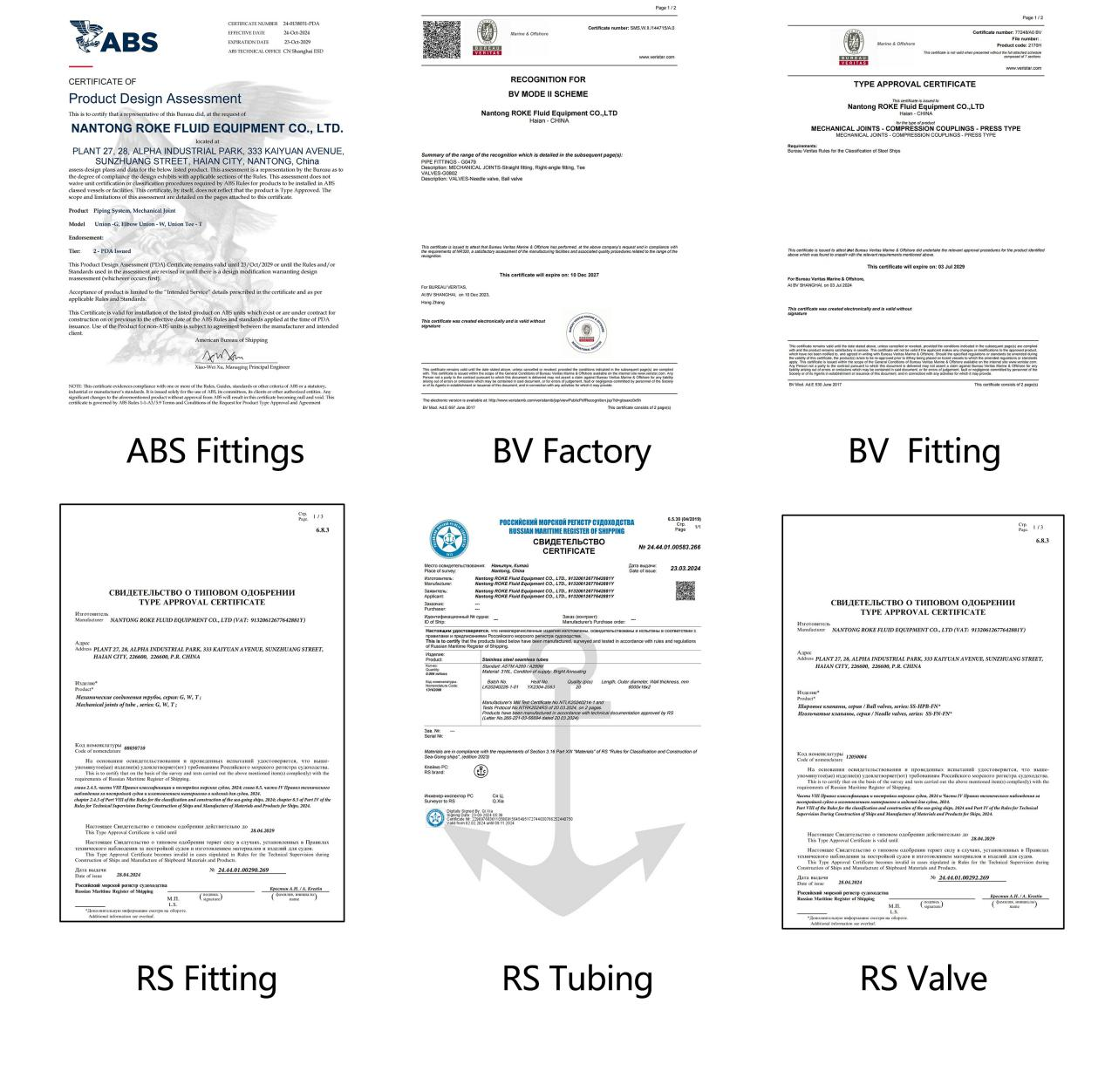
Certification portfolios require interpretation, not just verification. Different approvals serve different functions, and matching them to specific end applications determines whether a supplier is genuinely qualified for a procurement context. BV (Bureau Veritas) and ABS (American Bureau of Shipping) approvals satisfy marine classification requirements for shipbuilding and vessel equipment supply chains. DNV (Det Norske Veritas) certification addresses offshore platform and subsea application standards. CE marking is a regulatory prerequisite for products entering European markets under the Pressure Equipment Directive. ISO 9001 provides the process management baseline that underpins high-volume procurement relationships across all industries. Holding all five simultaneously — as ROKE does — is not credential redundancy. It reflects the operational reality that global procurement teams often supply into multiple regulatory environments from a single sourcing relationship. A manufacturer whose certification portfolio spans all five removes the need to qualify separate suppliers for different regional or application-specific requirements, reducing supplier management complexity and improving traceability across market entry points.
Assess Foreign Trade Capability as Part of the Supply Chain Risk Profile
Technical qualification criteria dominate supplier evaluation frameworks, but foreign trade infrastructure deserves equal attention in international procurement. A manufacturer without independent export rights operates through trading company intermediaries — adding cost layers, reducing direct communication access, and inserting a non-manufacturing entity between the buyer and the production facility. This arrangement limits traceability and slows response times on technical queries, specification changes, and quality incidents. Conversely, a manufacturer with independent export rights manages customs documentation, shipping coordination, and export classification directly. With more than sixteen years of international trade experience and independent export rights, ROKE engages directly with international procurement teams on product specifications, delivery scheduling, and documentation requirements — without the intermediary layer that trading company channels introduce. Beyond trade infrastructure, digital procurement capability matters. Product catalog availability for download, online ordering platforms, and direct technical inquiry support reduce the administrative friction that slows procurement cycles, particularly for repeat orders and specification verification.
What a Manufacturer Evaluation Should Cover
Consolidating the criteria above into a consistent evaluation process produces more reliable supplier qualification outcomes than ad hoc assessment. Material documentation should be traceable to specific mill certificates, not generic grade claims. Manufacturing standard compliance should appear in product specifications, not only in marketing descriptions. Production process controls should include documented inspection frequency and non-conformance closure procedures. Certification currency and scope should be verified at the product category level, since a company-level ISO certificate does not automatically extend to every product line. Product breadth should be assessed relative to system requirements, not evaluated in isolation. Foreign trade capability, including independent export rights and digital procurement support, should factor into total procurement cost and administrative burden calculations. Applying these criteria systematically across multiple supplier assessments — rather than revisiting them case by case — builds a repeatable qualification process that improves sourcing decisions over time.
From Criteria to Decision
High-pressure fittings define more than a connection point. They set maintenance intervals, spare parts compatibility requirements, and system upgrade pathways across the operational life of the equipment they serve. A manufacturer selected through rigorous evaluation — on material traceability, standard alignment, production consistency, certification coverage, and trade infrastructure — becomes a long-term supply partner rather than a transactional vendor relationship. The criteria outlined in this guide are not exhaustive, but they address the dimensions of supplier capability that most directly affect system reliability and procurement risk. Engineering and procurement teams seeking full product specifications, certification documentation, or supplier qualification support for stainless steel fittings can access ROKE's complete product catalog at https://www.chinaroke.com/.
Nantong Roke Fluid Equipment Co., Ltd.
Nantong Roke Fluid Equipment Co., Ltd.
+86 513-85400443
admin@ntroke.com
Legal Disclaimer:
EIN Presswire provides this news content "as is" without warranty of any kind. We do not accept any responsibility or liability for the accuracy, content, images, videos, licenses, completeness, legality, or reliability of the information contained in this article. If you have any complaints or copyright issues related to this article, kindly contact the author above.
