

How Does ROKE Ensure Global Leading Sturdy And Reliable Check Valve Performance Under ABS and DNV Standards

What ABS and DNV Certification Actually Requires From a Check Valve Manufacturer
Certification from the American Bureau of Shipping and Det Norske Veritas represents more than a quality label. Both organizations conduct independent technical audits that examine design documentation, material traceability records, pressure testing protocols, and the production controls a manufacturer applies across its entire output. ABS approval carries specific relevance in North American offshore and shipbuilding procurement frameworks, while DNV certification serves as the baseline standard across European and international marine project specifications. Critically, neither organization accepts self-reported data as the basis for approval. Each certification requires documented evidence — from material sourcing through final inspection — that performance claims hold up under independent review. For procurement teams managing capital projects with long equipment lifecycles, this distinction between self-declared and independently verified quality is operationally significant.
The Engineering Risks That Make Check Valve Reliability Non-Negotiable
Check valves perform a deceptively simple function: they allow flow in one direction and prevent it in the other. However, the engineering requirements behind that function are demanding. A valve that fails to open at its specified cracking pressure starves downstream instrumentation of flow. Conversely, a valve that allows reverse flow under pressure surges contaminates sampling lines, damages sensors, and in gas systems creates ignition risk. Seat erosion from continuous media exposure gradually widens the leak path, allowing backflow at pressures well below the original cracking threshold. These failure modes appear across offshore platforms, petroleum transfer lines, chemical processing circuits, and shipboard instrumentation panels — environments where system accessibility is limited and unplanned maintenance carries compounding operational costs. Consequently, check valve selection in these contexts demands engineering evidence, not catalog promises.
How ROKE's CA Series Design Addresses Each Performance Dimension
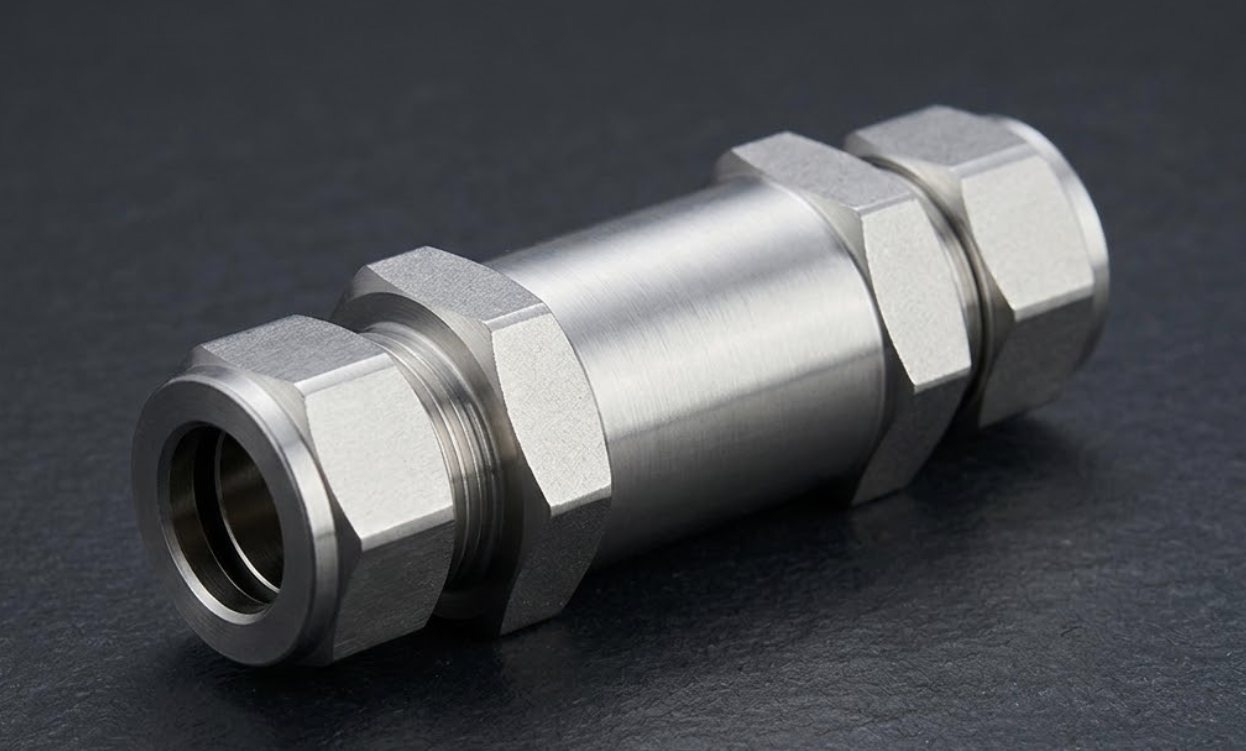
ROKE's Metric Double Ferrule Check Valves CA Series directly addresses the failure modes described above through a combination of material selection, mechanical design, and sealing architecture. The valve body uses SS316 stainless steel, providing corrosion resistance across oil, water, gas, and chemically aggressive process media. The cracking pressure range spans 0.007 to 0.1 MPa, and this range is selectable — allowing engineers to match opening resistance to the specific pressure differential present in their system. Fixed cracking pressure designs force engineers to accept a standard value that may not align with actual operating conditions. Selectable cracking pressure eliminates that compromise. Beyond opening performance, the valve seat ring design provides continuous media flushing, which prevents secondary contamination — a critical requirement in instrumentation sampling lines where fluid purity directly affects measurement accuracy. The maximum working pressure reaches 6000 PSI (413 BAR), with an operating temperature ceiling of 190 degrees Celsius. These parameters cover the instrumentation requirements across the majority of industrial and offshore applications. Furthermore, ROKE's check valve portfolio extends across metric and inch double ferrule CA series configurations, along with male and female thread CP, CPA, and CH series variants. This range covers the full spectrum of connection type requirements that engineering teams encounter across diverse system architectures.
From Cracking Pressure Consistency to Seat Integrity — What the Manufacturing Process Must Deliver
ABS and DNV audits do not evaluate product samples in isolation. They examine the production environment that generates those samples — assessing process controls, tooling standards, material documentation workflows, and quality assurance systems. This means a manufacturer's physical and operational infrastructure directly determines whether certification is achievable and sustainable. ROKE operates two self-managed production facilities in Hai'an, Nantong, running 20 automated production lines with a combined monthly output exceeding 2 million units across its valve, fitting, and seamless tubing categories. In spring-loaded check valve production specifically, automated assembly processes reduce unit-to-unit spring rate variation — the variable that governs cracking pressure consistency across a production batch. Manual assembly introduces variation that accumulates across high-volume runs. Automated tooling maintains dimensional and force tolerances within narrower bands. For buyers who specify a cracking pressure value and expect it to hold across every unit in a shipment, this production consistency is not a secondary consideration. It is the core delivery requirement.
How ABS and DNV Approval Integrates With ROKE's Full Certification Portfolio
ABS and DNV approvals address marine and offshore classification requirements. However, ROKE's certification structure extends beyond these two organizations. Bureau Veritas provides an additional independent manufacturing audit layer. ISO quality management certification documents process consistency across the full production workflow. CE conformity marking addresses European pressure equipment directive requirements. Together, these credentials form a layered compliance framework that satisfies the overlapping regulatory demands of complex international projects. A subsea installation project, for example, may require DNV for offshore classification, CE for European equipment compliance, and ISO for supplier quality system verification — all simultaneously. Sourcing from a manufacturer whose certification portfolio spans all three removes the need to qualify multiple suppliers to cover different compliance requirements. This consolidation reduces procurement complexity without sacrificing compliance coverage.
What Certified Check Valve Sourcing Means for International Project Procurement
The practical value of certification lies in how it affects the supplier qualification process. Engineers and procurement officers managing capital projects in oil and gas, shipbuilding, and offshore engineering must document their component selection decisions against defined technical and compliance standards. A supplier who provides ABS and DNV certified products, backed by ISO-governed production records and independently audited material traceability, substantially reduces the documentation burden that internal qualification teams carry. ROKE maintains independent export rights and has established trade channels across international markets, serving petroleum, chemical, power generation, shipbuilding, and water treatment industries. Direct factory procurement provides access to material test reports, batch inspection records, and compliance certificates without the documentation gaps that distribution intermediaries frequently introduce. For wholesale procurement, dedicated technical support and direct quotation access streamline the commercial side of the supplier relationship. Ultimately, the combination of verified product performance, multi-standard certification coverage, and direct manufacturing access positions ROKE as a supply partner capable of meeting the full technical and administrative requirements of serious international project procurement — not merely a component vendor with a certificate on file.
For complete product specifications and procurement inquiries, visit https://www.chinaroke.com/.
Nantong Roke Fluid Equipment Co., Ltd.
Nantong Roke Fluid Equipment Co., Ltd.
+86 513-85400443
admin@ntroke.com
Legal Disclaimer:
EIN Presswire provides this news content "as is" without warranty of any kind. We do not accept any responsibility or liability for the accuracy, content, images, videos, licenses, completeness, legality, or reliability of the information contained in this article. If you have any complaints or copyright issues related to this article, kindly contact the author above.
