

Air Defense Systems Market Set to Reach USD 47.92 Billion by 2035 Amid Rising Demand for Multi-Layered Missile Defense
Air Defense Systems Market
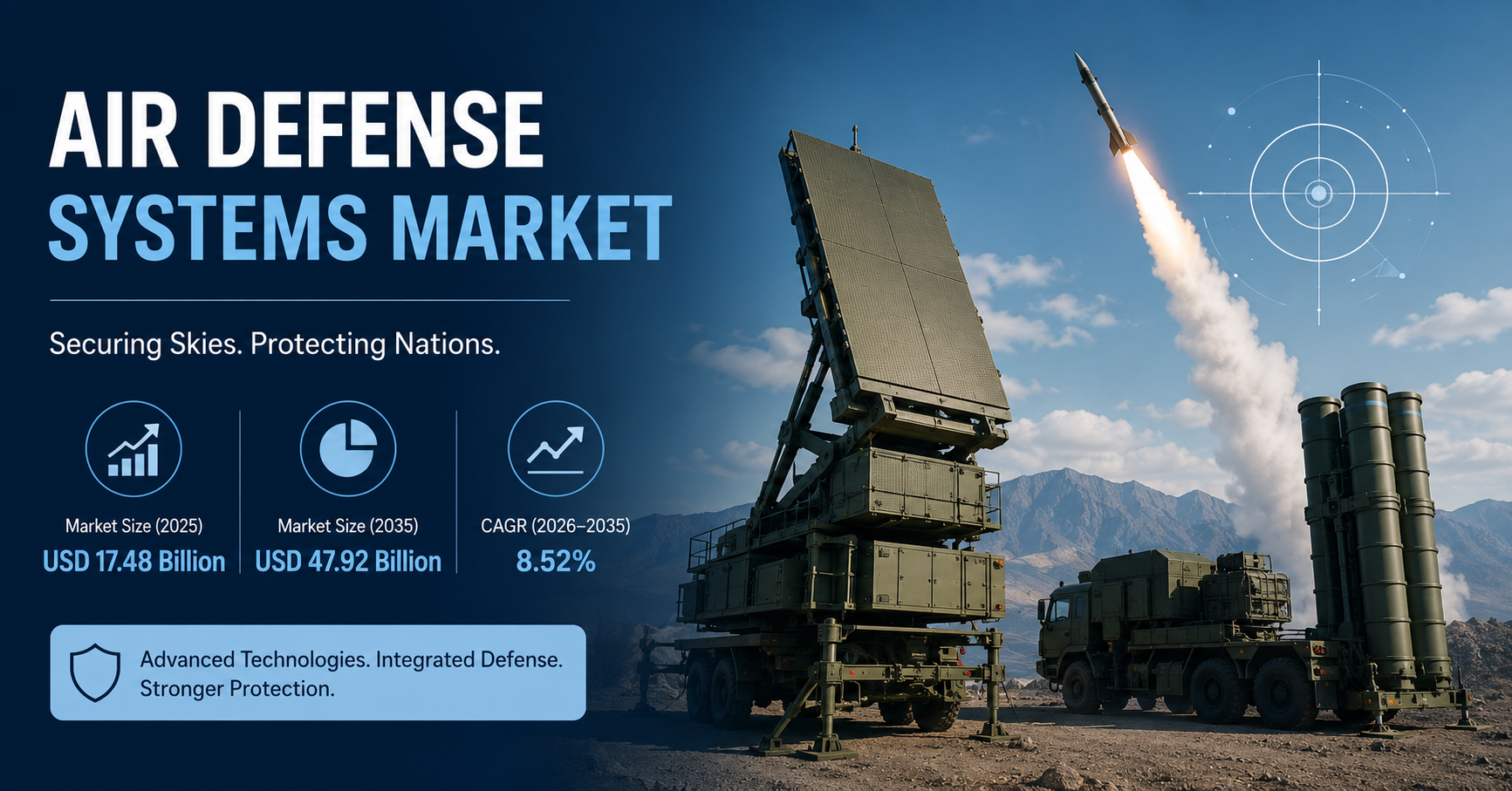
According to Market Research Future (MRFR), the Air Defense Systems Market was valued at USD 17.48 billion in 2025 and is estimated to grow from USD 18.89 billion in 2026 to USD 47.92 billion by 2035, registering a CAGR of 8.52% during the forecast period from 2026 to 2035. The market’s expansion is being fueled by rising defense modernization initiatives, increasing geopolitical tensions, and the growing need for layered defense networks capable of addressing sophisticated airborne threats.
Market Overview:
Air defense systems play a critical role in safeguarding military installations, strategic infrastructure, urban centers, and national borders from hostile airborne attacks. Modern systems combine radar technologies, missile interceptors, command-and-control platforms, fire control mechanisms, and electronic warfare capabilities to create a comprehensive shield against a broad spectrum of threats.
The evolution of warfare has significantly altered defense priorities. Conventional air defense architectures designed primarily to counter manned aircraft are increasingly being replaced by integrated air and missile defense frameworks capable of handling simultaneous attacks from multiple vectors. These next-generation systems incorporate advanced sensors, artificial intelligence-enabled threat assessment tools, real-time data fusion, and network-centric command structures to enhance operational effectiveness.
As defense organizations focus on achieving greater situational awareness and faster response times, demand for technologically advanced air defense solutions is expected to remain strong throughout the forecast period.
Key Market Drivers:
1. Rising Geopolitical Tensions and Security Concerns
Growing geopolitical instability across several regions has prompted nations to strengthen their defense preparedness. Territorial disputes, cross-border conflicts, and evolving security challenges have led governments to increase military spending, particularly on air defense capabilities. The growing threat posed by advanced missile systems and unmanned aerial platforms has intensified the need for robust defense infrastructures. As countries seek to safeguard strategic assets and maintain national security, investments in air defense technologies continue to increase.
2. Expansion of Defense Modernization Programs
Many countries are actively upgrading legacy defense systems with modern platforms that offer enhanced detection accuracy, extended engagement ranges, and improved interoperability. Military modernization initiatives are encouraging procurement of advanced missile defense systems, directed-energy weapons, and integrated command-and-control solutions. The transition from isolated defense assets toward networked defense ecosystems is creating substantial opportunities for system integrators and technology providers.
3. Growing Threat from Unmanned Aerial Systems
The widespread use of drones in modern warfare has emerged as a significant catalyst for market growth. Low-cost drones and drone swarms present unique operational challenges due to their agility, affordability, and ability to overwhelm conventional defense mechanisms. As military organizations seek effective counter-UAV solutions, air defense systems equipped with advanced tracking, electronic warfare, and interception capabilities are witnessing increased adoption. Emerging counter-drone technologies are becoming an integral component of modern air defense strategies.
4. Increasing Demand for Multi-Layered Defense Architectures
Modern aerial threats require multiple layers of defense capable of intercepting targets at different ranges and altitudes. Governments are increasingly deploying integrated systems that combine short-range, medium-range, and long-range capabilities to establish comprehensive protection. This shift toward multi-layered defense frameworks is driving demand for sophisticated command-and-control systems, advanced sensors, and interoperable missile platforms.
Request Sample PDF of Report: https://www.marketresearchfuture.com/sample_request/30000
Emerging Market Opportunities:
1. Adoption of Directed-Energy Weapons
Directed-energy technologies are gaining prominence within the defense sector due to their ability to engage targets rapidly and cost-effectively. Laser-based and high-energy systems offer significant advantages when countering drones and other low-cost aerial threats. As technological advancements improve power generation, beam control, and targeting precision, directed-energy weapons are expected to become a key component of future air defense networks.
2. Artificial Intelligence and Autonomous Decision Support
Artificial intelligence is transforming air defense operations by enhancing target identification, threat prioritization, and engagement planning. AI-enabled systems can process vast amounts of sensor data in real time, enabling faster and more accurate decision-making. The integration of machine learning algorithms and autonomous command capabilities is expected to improve operational efficiency and support the development of next-generation defense architectures.
3. Space-Based Surveillance and Sensor Integration
The increasing deployment of space-based sensors and satellite networks is creating new opportunities for air defense modernization. These technologies enhance early-warning capabilities and improve tracking of advanced threats beyond the reach of traditional radar systems. The integration of space assets with terrestrial and airborne defense infrastructure is expected to significantly strengthen future air defense capabilities.
4. Expansion in Emerging Defense Markets
Rapid military modernization programs across Asia-Pacific, the Middle East, and parts of Eastern Europe are generating substantial demand for advanced defense systems. Governments in these regions are allocating larger portions of defense budgets toward air and missile defense procurement, creating attractive opportunities for manufacturers and technology providers.
Latest Market Trends:
1. Integrated Air and Missile Defense Networks
One of the most significant trends shaping the market is the development of integrated defense ecosystems that connect land-based, sea-based, airborne, and space-based assets into a unified operational framework. These systems enable real-time information sharing and coordinated threat responses.
2. Increasing Focus on Counter-Hypersonic Capabilities
The emergence of hypersonic missiles has accelerated investments in advanced tracking and interception technologies. Defense agencies are increasingly focusing on systems capable of detecting and neutralizing highly maneuverable threats traveling at extreme speeds.
3. Growth of Sensor Fusion Technologies
Modern air defense systems increasingly rely on sensor fusion technologies that combine information from multiple sources to create a comprehensive operational picture. This trend enhances target tracking accuracy and improves response effectiveness.
4. Expansion of Electronic Warfare Solutions
Electronic warfare capabilities are becoming increasingly important in modern air defense operations. Soft-kill technologies that disrupt enemy communications, navigation systems, and guidance mechanisms are gaining traction as complementary tools alongside kinetic interception systems.
Segment Analysis:
1. By System Type
Missile Defense Systems - The Missile Defense Systems segment represents a significant share of the market due to the growing need to counter ballistic missiles, cruise missiles, and other advanced threats. Continuous investments in interceptor technologies and radar networks are supporting segment growth.
Anti-Aircraft Gun & SAM Systems - Anti-Aircraft Gun & SAM Systems remain critical components of national defense infrastructures. These systems provide reliable protection against hostile aircraft and short-range threats while offering rapid deployment capabilities.
Directed-Energy Weapons - Directed-Energy Weapons are emerging as one of the most promising segments within the market. Their ability to engage multiple targets at comparatively low operational costs is attracting significant defense investments.
Electronic Warfare / Soft Kill - Electronic Warfare / Soft Kill systems are experiencing growing adoption as militaries seek non-kinetic methods to neutralize airborne threats. These systems enhance operational flexibility and reduce dependence on traditional interceptors.
2. By Platform
Land-Based - Land-Based platforms account for a substantial market share owing to their widespread deployment for territorial defense and protection of critical infrastructure. These systems form the backbone of national air defense networks.
Sea-Based - Sea-Based air defense systems are increasingly important for protecting naval assets and maritime trade routes. Modern warships are being equipped with sophisticated missile defense and surveillance technologies.
Airborne - Airborne platforms provide enhanced mobility and extended surveillance coverage. The integration of advanced sensors and communication systems is supporting growth within this segment.
3. By Range
Short-Range - Short-Range systems are primarily deployed to counter drones, helicopters, and low-flying aircraft operating within limited engagement zones.
Medium-Range - Medium-Range systems provide versatile protection against a broader range of aerial threats and are widely utilized within layered defense frameworks.
Long-Range - Long-Range systems play a critical role in strategic defense by enabling early interception of incoming threats at extended distances. Governments continue to invest heavily in long-range capabilities to strengthen national security.
4. By Subsystem
Weapon Systems - Weapon Systems remain central to air defense operations, providing the interception and neutralization capabilities required to address evolving threats.
Fire Control Systems - Fire Control Systems support precise target tracking and engagement, improving mission effectiveness and reducing response times.
Command & Control - Command & Control solutions facilitate coordination across multiple defense assets and enable integrated operational decision-making.
Launch Systems - Launch Systems continue to evolve with advancements in mobility, automation, and interoperability, enhancing deployment flexibility and mission readiness.
5. By Technology
Kinetic-Kill Effectors - Kinetic-Kill Effectors continue to dominate the market due to their proven effectiveness in neutralizing a wide variety of airborne threats.
Directed-Energy Effectors - Directed-Energy Effectors are gaining attention as militaries seek scalable and cost-efficient alternatives to conventional missile interceptors.
Electronic / Soft-Kill - Electronic / Soft-Kill technologies are becoming increasingly important as defense organizations adopt layered protection strategies incorporating both kinetic and non-kinetic capabilities.
Regional Analysis:
North America - North America remains the largest regional market, accounting for approximately 36% of global revenue. The region benefits from substantial defense budgets, continuous modernization efforts, and strong investments in missile defense technologies. Ongoing procurement programs and advanced research initiatives continue to strengthen the region’s market position.
Europe - Europe represents the second-largest market with an estimated share of around 28%. Increased defense spending across NATO member nations and heightened security concerns have accelerated investments in integrated air defense capabilities. The region continues to prioritize modernization programs and cross-border defense cooperation.
Asia-Pacific - Asia-Pacific is projected to be the fastest-growing regional market, registering a CAGR of approximately 9.8% during the forecast period. Rising military expenditures, regional security concerns, and ongoing defense modernization programs in countries such as India and South Korea are driving market expansion. Governments across the region are actively investing in advanced missile defense and surveillance technologies.
Rest of the World - Countries across the Middle East, Latin America, and Africa are increasingly investing in air defense systems to enhance national security and protect critical infrastructure. The adoption of advanced defense technologies in these regions is expected to contribute to sustained market growth over the coming years.
Competitive Landscape:
The Air Defense Systems Market is highly competitive, with leading defense contractors and aerospace technology providers continuously investing in advanced interception technologies, radar systems, command-and-control platforms, and integrated defense solutions. Market participants are focused on strengthening their technological capabilities through strategic collaborations, research and development initiatives, defense procurement contracts, and portfolio expansion efforts to address evolving aerial and missile threats. Major companies operating in the market include:
Lockheed Martin Corporation
RTX Corporation (Raytheon)
Northrop Grumman Corporation
BAE Systems plc
Thales Group
Saab AB
Leonardo S.p.A.
Kongsberg Gruppen ASA
Rafael Advanced Defense Systems Ltd.
Almaz-Antey
These companies play a pivotal role in advancing next-generation air defense capabilities through the development of sophisticated missile interception systems, multi-domain surveillance solutions, integrated battle management platforms, and electronic warfare technologies. Their continued emphasis on innovation and modernization is enabling defense forces worldwide to enhance operational readiness and strengthen protection against increasingly complex airborne threats.
Furthermore, industry leaders are prioritizing the integration of artificial intelligence, sensor fusion technologies, autonomous threat assessment systems, and network-centric warfare capabilities to improve detection accuracy, engagement efficiency, and response times. As governments worldwide continue to modernize their defense infrastructure, these companies are expected to remain at the forefront of technological advancements and market expansion throughout the forecast period.
Recent Developments:
June 2026 - Market participants intensified investments in integrated air and missile defense architectures designed to improve interoperability among land, sea, air, and space-based assets, supporting faster threat detection and response capabilities.
April 2026 - Growing industry emphasis on counter-drone technologies encouraged defense contractors to expand development programs focused on low-cost interception and multi-layered protection systems against unmanned aerial threats.
February 2026 - Several defense organizations accelerated the deployment of advanced sensor-fusion and command-and-control technologies aimed at enhancing battlefield awareness and improving engagement accuracy against complex aerial threats.
December 2025 - The adoption of next-generation tracking and surveillance capabilities continued to gain momentum as governments pursued stronger defenses against emerging missile and hypersonic threats.
October 2025 - Defense manufacturers increased focus on electronic warfare and soft-kill solutions, supporting the development of layered defense strategies capable of addressing both conventional and asymmetric airborne threats.
Future Outlook:
The Air Defense Systems Market is expected to experience sustained growth through 2035 as nations continue to strengthen their military capabilities in response to evolving security challenges. Increasing defense budgets, technological advancements, and the growing importance of integrated defense architectures will remain central to market expansion.
The convergence of artificial intelligence, directed-energy weapons, advanced sensors, electronic warfare capabilities, and space-based surveillance technologies is expected to redefine the future of air defense operations. As governments prioritize comprehensive protection against increasingly sophisticated aerial threats, the market is positioned for substantial long-term growth.
With projected revenues reaching USD 47.92 billion by 2035 and a CAGR of 8.52%, the Air Defense Systems Market represents one of the most strategically significant segments within the global defense industry, offering considerable opportunities for technology developers, defense contractors, and government stakeholders alike.
Browse More Reports:
Man Portable Air Defense Systems Manpad Market
https://www.marketresearchfuture.com/reports/man-portable-air-defense-systems-manpad-market-26802
Short Range Air Defense System Market
https://www.marketresearchfuture.com/reports/short-range-air-defense-system-market-33045
Naval Vessel Defense System Market
https://www.marketresearchfuture.com/reports/naval-vessel-defense-system-market-42459
Sagar Kadam
Market Research Future
+1 628-258-0071
sales@marketresearchfuture.com
Visit us on social media:
LinkedIn
Facebook
X
Legal Disclaimer:
EIN Presswire provides this news content "as is" without warranty of any kind. We do not accept any responsibility or liability for the accuracy, content, images, videos, licenses, completeness, legality, or reliability of the information contained in this article. If you have any complaints or copyright issues related to this article, kindly contact the author above.
